

Open Protocols (and Why Size Matters) in Publishing
Some thoughts from London.

I haven’t written about the media industry for a while, mostly because I’ve been busy with a more important project. Now that this project has turned one, learned how to walk, babble, and started daycare, I found myself debating whether to retire this newsletter altogether or, for some vaguely masochistic reason, bring it back to life.
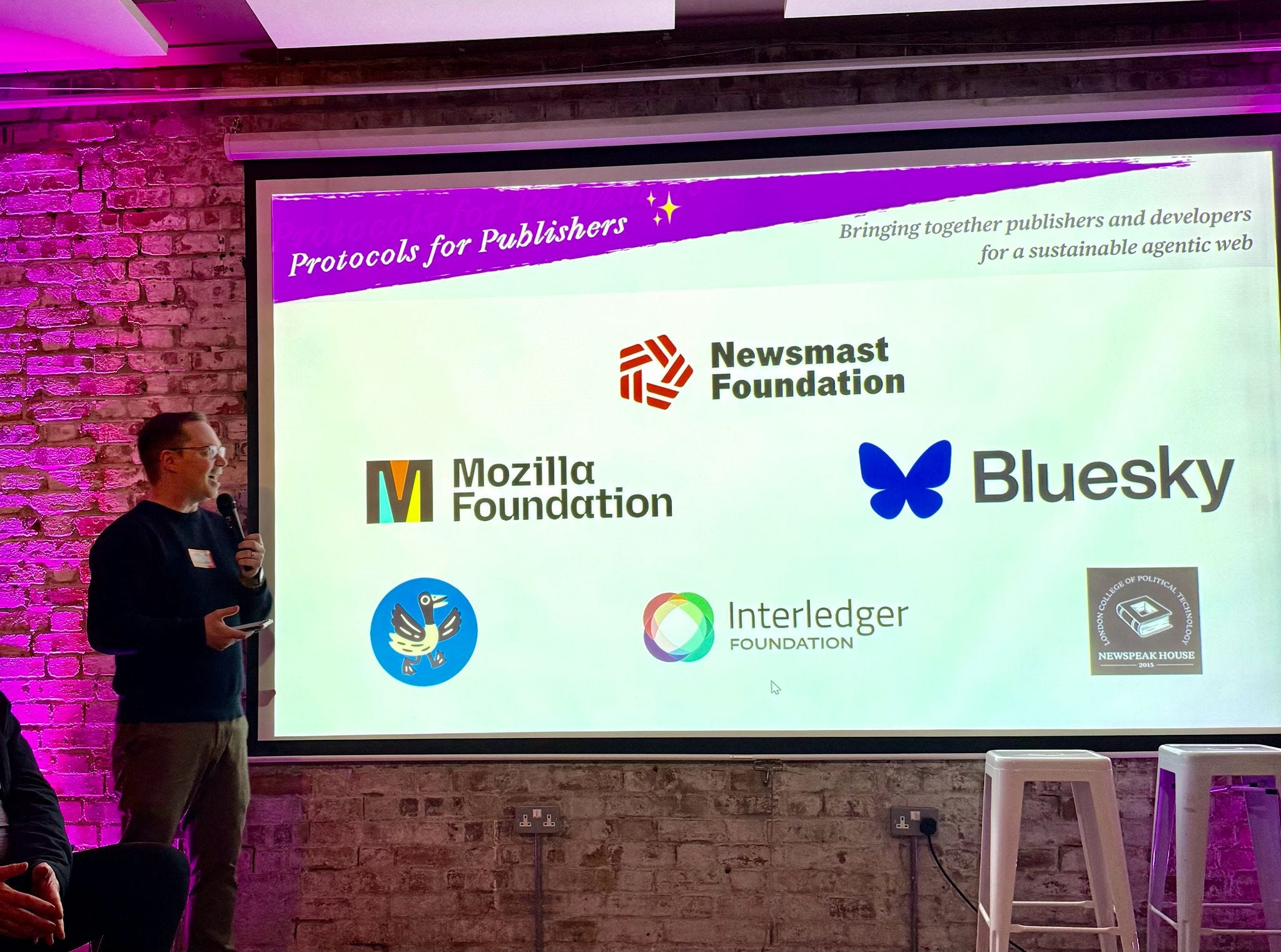
Fate intervened in the form of a somewhat unusual event. I found myself in London, at a gathering called Protocols for Publishers, held at Newspeak House. A few dozen people came together there: some from the open web and open protocols world, such as Mastodon, Bluesky, and the Mozilla Foundation; others from the media world, including the BBC and ProPublica. Some sit somewhere in between, trying to act as a bridge between the technical possibilities of open protocols and the very real needs of media organisations attempting to reduce their dependence on Big Tech.
Anyone working in the media industry knows how difficult it is to break that dependence.
The event was structured as a series of “listening sessions”. In practice, this made it possible to see not only where participants broadly agreed, but more importantly, where their problems and interests diverged. It became clear fairly quickly that many of these discussions ultimately hinged on one factor: the size of the publisher and the level of power they still retain.
All publishers operate within the same distribution environment - search, social media, and increasingly AI-mediated discovery. However, the effects of that environment are not the same, nor are the risks distributed evenly, particularly once the ability to maintain a direct relationship with audiences begins to erode.
For publishers, changes to platform algorithms that drive traffic mean a loss of control and predictability. For smaller publishers, this often also means losing what little direct relationship with their audience they still have. As a result, there was a fairly broad consensus that open protocols currently offer more tangible value to smaller publishers than to larger ones.
A particularly interesting example is The Bristol Cable. This local outlet is unusual in several ways: rather than being owned by a media corporation, it is owned by thousands of citizens. For over a decade, this membership-based model has allowed the organisation to move away from a focus on clicks and instead invest in strong, public-interest journalism. More recently, with the help of open protocols, they have built a mobile app that not only delivers news but also enables connections between journalists and members, as well as access to other global news sources.
Such a model, however, presupposes a strong and long-term engaged local community.
It’s an inspiring example, but cases like this remain sporadic rather than representative of broader practice in the media industry. Only a small number of publishers have successfully mastered the subscription model, while advertising - despite the share increasingly captured by Big Tech - continues to dominate. On top of that, many outlets are experimenting with various “products”, from live events to, in some cases, games bundled into subscriptions.
Beyond serving as something of a collective complaining session for publishers, the conversations in London did generate a number of ideas. More importantly, they helped weaken - if not fully dismantle - the barrier between publishers and experts working on open protocols. Two days, however, were not enough to resolve all the challenges, let alone those introduced by large language models through scraping and the reuse of media content, often accompanied by a reduction in traffic back to that same content. That is clearly a topic for future conversations.
If nothing else, the event prompted me to dust off my Bluesky and Mastodon profiles, which I had created in a somewhat desperate attempt to fill the gap left by Twitter. This immediately reconnected me with people I hadn’t spoken to in years. It also made me think more seriously about how I might communicate more directly with my audience.
Believe it or not, a newsletter is one such way - so I’m glad you’re still here.
Do you have any others? Let me know, especially if they involve open protocols. I’d like to learn more.
Welcome back! 🥂